
Agents, Explained — What They Actually Are
A plain-English breakdown of AI agents: what they are, how the agentic harness works, and why the founders adopting them get ahead.

Since I published my OpenClaw blog, the rise of agents has become genuinely prevalent. People are finally realising that AI is actually doing stuff now — not just being a chatbot that spits text back at you. It’s creating software, running tasks, and harnessing what we call an agentic harness to get a desired output.
So in this one I want to break down what an agent actually is. No jargon for the sake of jargon. Just the real picture.
So What Is an Agent?
Strip away the hype and an agent is pretty simple to picture.
At the centre you’ve got a large language model — the LLM. That’s the brain. On its own, a model just predicts text. Useful, but it can’t act. It can’t open a file, search the web, send an email, or run code. It just talks.
An agent is what you get when you wrap that model in a harness that lets it actually do things and loop. You give it a goal, it reasons about what to do, it reaches for a tool, it looks at the result, and then it decides the next step — over and over until the job is done. That loop is the whole game.
That’s the bit most people miss. It’s not the model that’s magic. It’s the harness around it.
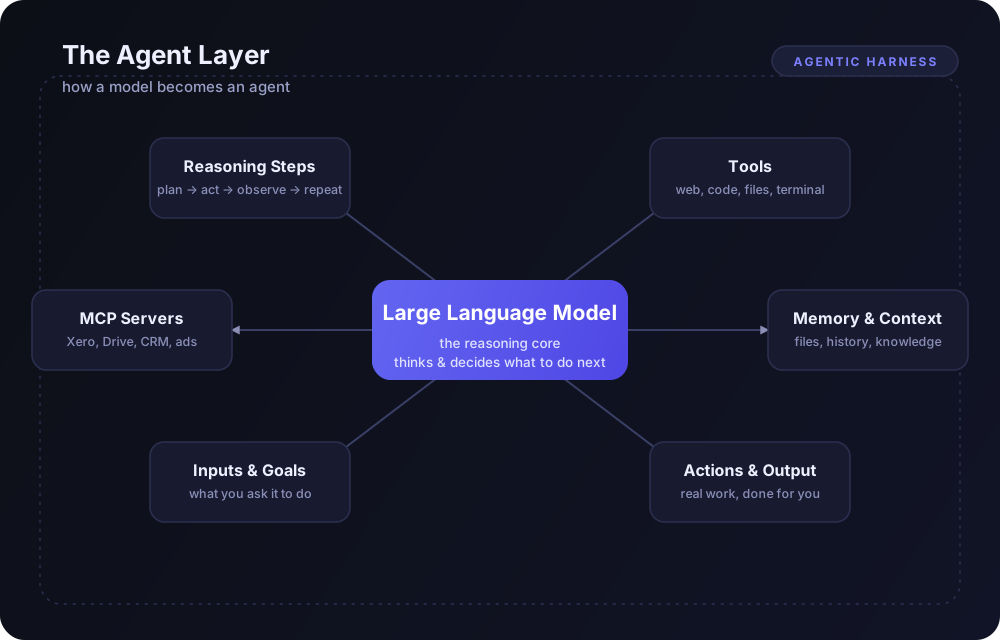
Look at the diagram above. The LLM sits in the middle. Around it:
- Reasoning steps — the agent doesn’t fire once and stop. It plans, acts, looks at what happened, and goes again. Plan → act → observe → repeat.
- Tools — the ability to search the web, run code, read and write files, use a terminal. This is how the model reaches out and touches the real world.
- MCP servers — a standard way to plug the agent into your actual platforms. Xero, Google Drive, your CRM, your ad accounts. (More on this below.)
- Memory & context — what the agent knows. The files, the history, the knowledge you’ve fed it so it isn’t starting from zero every time.
- Inputs & goals — what you ask it to do.
- Actions & output — the real work that comes out the other end.
Wrap all of that together and you’ve got the agentic harness. The model is the engine, but the harness is the car. You don’t drive an engine.
Why “Sequential” Is the Bit That Changes Everything
Here’s the part that clicked for me and I think clicks for most people once they get it.
Because the brain in the middle is a large language model, an agent doesn’t just do one thing — it can process work sequentially. It can take a goal, break it into steps, do step one, check the result, adjust, then do step two. It reasons its way through a problem the way a person would, just a lot faster and without getting bored.
That’s the difference between a chatbot and an agent. A chatbot answers. An agent works through something. It can chain dozens of steps together, recover when something fails, and keep going until it hits the outcome you actually asked for.
The rate at which you can produce things and get things done with this is, frankly, extremely powerful.
The Tools Founders Are Actually Using
As I touched on in the OpenClaw piece, there’s a growing list of software out there for this.
On the open-source side there’s OpenClaw and Hermes Agent — free, transparent, and you can run them yourself. And then there are the proprietary ones coming straight out of the big AI labs, which are the ones I’d normally point most people to: Claude Code from Anthropic and Codex from OpenAI.
Here’s the thing, though — in my opinion there’s no clear winner. None of these is flat-out better than the others. They’re all strong. It comes back to the point from earlier: the model is the brain, and the harness is the layer wrapped around it. What actually decides the quality of your output isn’t which logo is on the box — it’s how you harness it for the specific task in front of you. Get that right and any of these will do remarkable work.
And this isn’t just my take. A 2026 Stanford-led study, Meta-Harness, found that “changing the harness around a fixed large language model can produce a 6× performance gap on the same benchmark.” Same model, same test — the only difference is the code wrapped around it, and performance swings sixfold. They went on to show that automatically improving the harness beat expert hand-built setups across classification, math, and coding tasks, while using up to 4× fewer tokens. The wrapper isn’t a detail. It’s often the whole difference.
These tools are extremely powerful if you harness them right. And in my opinion, every founder should have at least used one of these by now, if not be using one daily. The founders getting their hands dirty with this stuff today are the ones who are going to be ahead. Not in five years — in twelve months.
Because the rate at which you can produce things, ship things, and get things done is on another level. These agents don’t just do a task; they can sit and work through a whole problem sequentially, because at their core they’re a large language model that can reason step by step.
”But Isn’t This Just for Developers?”
This is the biggest misconception I run into. People see the word code in “Claude Code” or hear it’s a terminal tool and assume it’s only for software engineers and IT people. It’s not.
I think everyone should be using these tools right now — because this is where the future is heading. Especially founders. And not in spite of the technical wrapper, but because of what it unlocks. An agent like this bridges the gap between software and being non-technical. You don’t need any coding expertise to get value from it. Its whole purpose is to take your goal and use its harness — the tools, the reasoning loop, the access to your files and systems — to get the job done for you. You direct; it does the work.
And one underrated part: it sits locally on your own computer. It can read your files, run things, and build real systems right there on your machine, under your control. That’s genuinely valuable — it’s not some locked-down chat window, it’s a capable operator working on your side of the screen.
Where This Goes for Your Business
This is the same thread I keep pulling on, and it’s why I keep writing about it.
Software used to take months or years and a full team to build. That’s gone. With an agent and a bit of direction, the barrier to building real, custom systems for your business has never been lower — I went deeper on that in The SaaS Squeeze.
Agents are the engine behind that shift. Once you understand that an agent is a reasoning brain wired into your tools, your data, and your workflows, you start to see what’s actually possible: systems that do the work, not just talk about it.
What To Do About It
This is what we do at Automate Wise — we help businesses adopt AI like this. We cut through the noise, work out where AI actually fits your business, and get it working — whether that’s building custom systems for you or training your team to do it themselves. No hype, no generic chatbots.
If you want to see what that looks like in practice, take a look at the systems we’re building, then book a conversation. That’s how you go from “agents are interesting” to “agents are saving us time and money.”
Related Posts
AI Implementation Starts With Your Team, Not Your Technology
The Automate Wise 15-20-65 framework explains why successful AI implementation depends more on people and existing systems than on the AI itself.
AI & DevelopmentOpenClaw — Stop Buying Mac Minis
Why OpenClaw is just hype and why non-technical people and businesses should not waste their time on it and what they should look at instead